
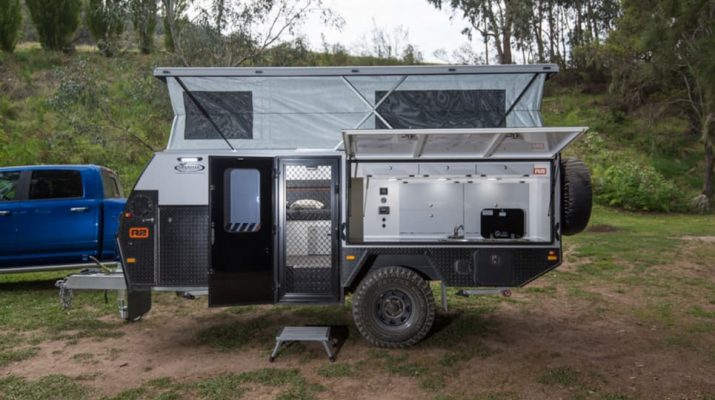
When it comes to camping, off roading or Van life in general – one of the things that often comes up is the use of camper trailers. Camper trailers are an awesome solution for some people when it comes to accommodation and camping needs, but not for everyone.
In this article I am going to give you a rundown on what exactly a camper trailer is, what would make one an off road camper trailer, and benefits they have / what needs they can fulfil so you can see whether it might be an appropriate design solution for your needs.
Introduction to Camper trailers
If you want to be able to live the #vanlife but also need a standard vehicle such as for your job, you don’t want to literally take your home with you everywhere you drive, you want a bit more space than is traditionally available within a vehicle, you only want to camp on weekends, you want to specialise in off road camping or you just aren’t that fussed about #stealthcamping, then potentially a camper trailer could be a good solution for you.
Obviously camper trailers are going to require a vehicle that is able to tow them, and aren’t going to be suitable for everyone. I think they are worth considering through, as they fulfil more than just a niche role in the camping community. It is worthwhile keeping them in mind when considering your Cost, Quality and Time principles when looking for your ideal camping solution.
There are a wide variety of camping trailers. Some of these you will recognise immediately like Caravans (which do come in offroading variants), but some might be a little bit more strange to you such as pop top or semi-hard caravans such as the A-van or Recon trailer. Finally, there are soft, or fold out camper trailers
Hard camper trailers: Caravans
Caravans are the simplest form of camper trailer and come in a variety of size, shapes and fit-outs. Usually built as a semi-monocoque design, the caravan gets its structural integrity from the stiffness of its walls rather than an internal structure – this is a good thing as it means more internal living space for you.
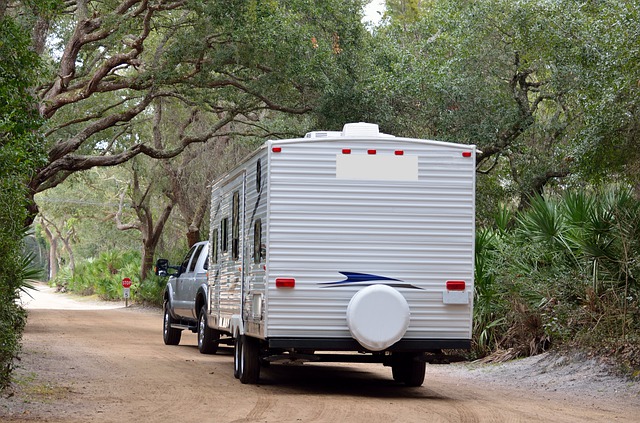
The walls often come insulated, which makes it more comfortable inside, and caravans can be bought ‘off the shelf’ as a great mobile camping solution. Luxury high end caravans can feature comprehensive electrical systems (solar panels, regulators, batteries, inverters and outlets, capable of external power too), bathrooms, water storage and plumbing, kitchens and even multiple beds.
Simpler caravans could literally just be a shell with a bed and some cupboards – and of course then there is everything in between with the wide range of caravans on the market today.
Larger, more luxury caravans are usually heavier, more expensive and have less of road capability – so of course it is a trade-off and you need to really think about what is your intended use for the camper trailer before rushing out and buying a hard shell caravan.

Off road caravans and Pop-up camper trailers
Off road caravans and Pop up camper trailers are a pretty smart solution for those wanting increased off road capability or a more ‘mobile’ friendly solution in general. With lower profiles, much lighter weights and (usually) increased ground clearance they make it easier (and cheaper!) to travel at higher speeds on the highway, as well as navigate through some more difficult or tight roads.
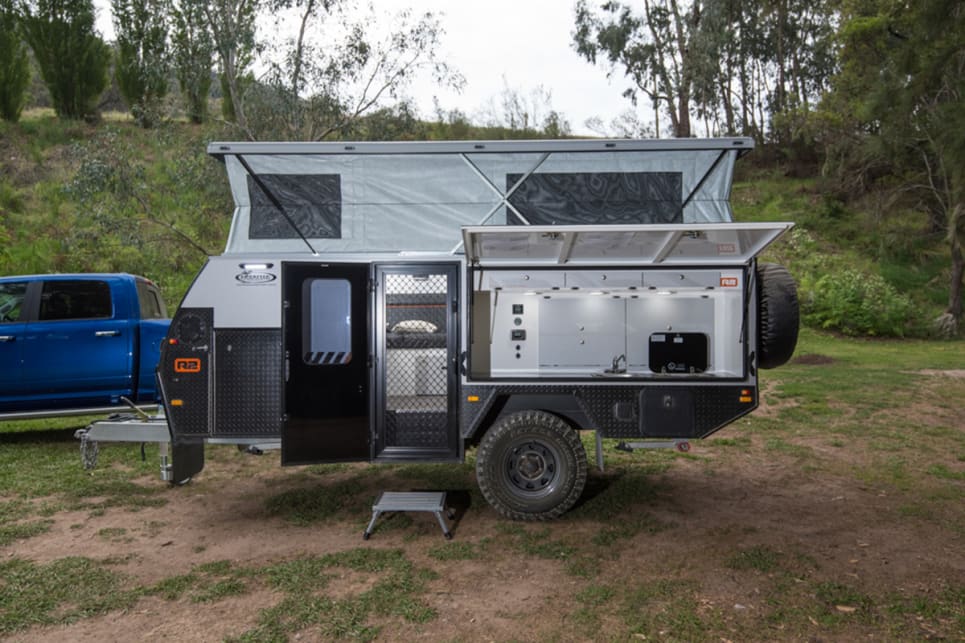
Typically, because pop up camper trailers will be fitted with a higher clearance (distance between the trailer and the ground), and larger tyres (such as muddies) they have better ground clearance angles meaning there is less chance you’ll end up getting stuck and having to unhitch your camper trailer to effect a recovery.
They usually have many if not all of the features of a larger conventional hard caravan (such as sinks, electricity and some storage), but of course will lack the insulation that a permanent wall will have, or the sheer amount of storage / cupboards.
Because the pop up section is usually made of canvass walls, this means pop up camper trailers are only really suited to more milder climates (such as Australia) and they become impractical in extremely hot, humid, cold or wet climates.
Further, because of the requirement for a reasonable ground clearance angle, pop up trailers like the Recon off road camper trailer above usually are shorter in overall length. This means there is less living space inside the camper trailer, which can make it cramped especially if its sleeping more than one or two for an extended period.
Ultimately I think this makes pop up camper trailers a great weekend or recreational solution for those wanting a bit more luxury, but not really practical for a permanent or semi-permanent living arrangement for most situations.
Soft camper trailers: Fold out Tent trailers
The polar opposite to a hard camper trailer like a caravan is of course, a soft camper trailer like a fold out tent. These are usually fully contained within a small trailer (such as a 6×4 foot single axle trailer) and are the lightest of all the camper trailers.
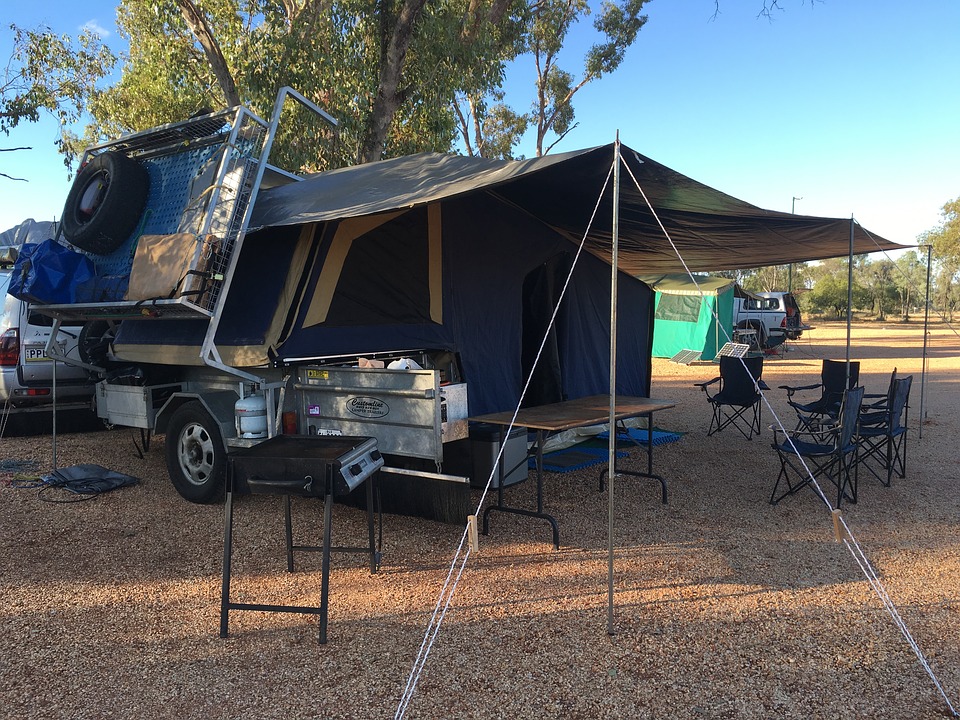
Fold out tent trailers are the typically the cheapest of all camper trailers, and the best suited to offroading due to their light weight, compact size and the ease of fitting off road tyres or higher clearance suspension to the trailer. They are also the easiest to tow, as when packed up their low profile has very little wind resistance and won’t put much of a strain on your engine.
The draw back? They take time to set up and require a bit of space to unfold your tent. This makes them a bit more subject to the vagaries of finding a good camp site; for example set your fold out tent on top of an ant nest or a water course then you’ll bloody know about it quick smart!
Fold out tents offer the least amount of protection and insulation from the elements, and if it rains I’ll be honest – your tent gets muddy very quick. These are difficult to keep clean and require a thorough deep clean after each use – when you get home after a trip you will need to unfold it all, wash it, let it dry etc and then pack it back up – otherwise it will be damaged by mildew and other mould, and any dirt inside will accelerate the wear and tear of the camper trailer.
They are also the most fragile of all of the camper trailers and will require the most frequent repair – they can be damaged by wind, stray embers from the fire, falling branches or by something as simple as falling into the side of the tent.
They are great in certain situations such as infrequent weekend pleasure camping with a larger family, and the low cost entry barrier means they are an affordable solution for many campers in mild climates.
Off road Camper trailers
Off road camper trailers are usually fold out tent or pop up camper trailers; although there are some off road caravans on the market. Generally speaking, a fold out tent is going to be your cheapest option and a purpose built, luxury off road caravan is going to set you back some serious coin (I have seen them advertised for over $150,000!)
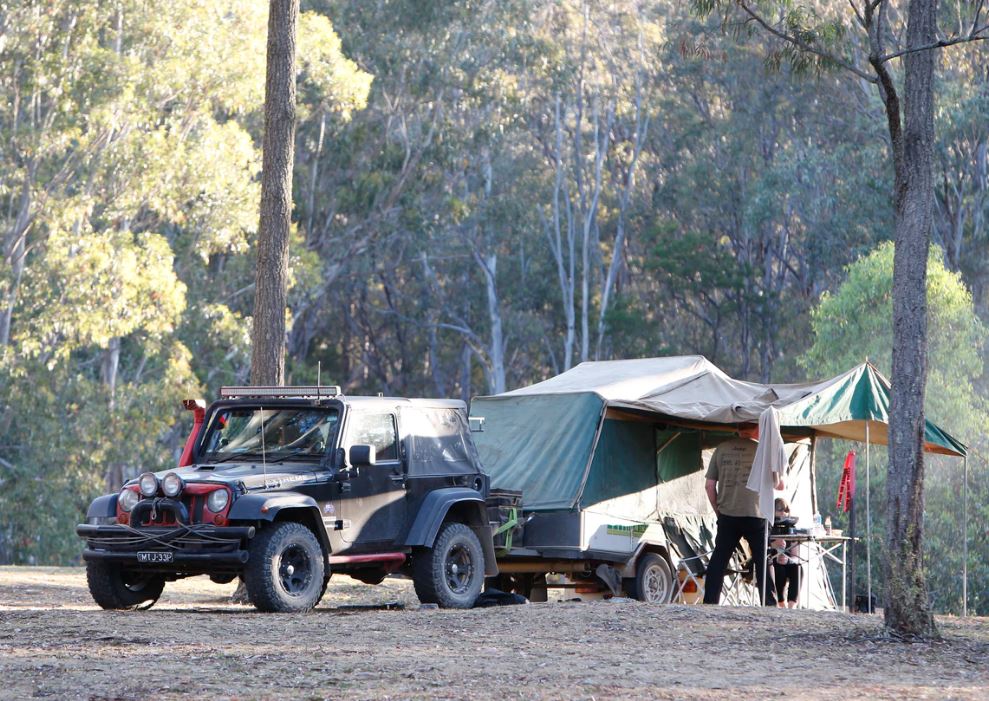
Ultimately it depends where you plan to take your off road camper trailer; a standard single axle 6×4 pop up tent trailer is usually the lightest option, and are pretty bulletproof in terms of where they can go. Because they are light, if you end up needing to do a recovery it is fairly easy to unhitch and winch or ‘manhandle’ them separately. They also happen to be the cheapest style of off road camper trailers.
Aspects you should consider when choosing an offroad camper trailer are weight, ground clearance (height), ground clearance angle (especially the hitch at the front) and overall size.
Realise that an off road camper trailer is going to be the limiting factor with your vehicle – you might have a great 4WD car, but the trailer will severely limit the capability of the car. Many trails are just not be suited for one at all. This could mean simply setting your camper trailer up at your campsite and then unhitching it as you go off exploring trails for the day.
What they can offer though, is the key to accessing hard to get to camping areas. This means you can explore areas that other campers can’t, and you get to access more pristine and untouched areas.
Summary of camper trailers
Camper trailers are worth considering for your camping needs. If you are only camping on weekends, semi permanently or don’t care about stealth camping or hardcore #Vanlife then they make a great viable and cost effective alternative to a van conversion.
Ultimately, its really important you understand and actually write down why you want a camper vehicle. You need to analyse your needs, wants and goals (NWG) to get your optimum design solution. There is no point spending $50,000 on fitting out a standard rear wheel drive LWB Mercedes sprinter if all you want to do is to go off road camping a few times a year!
I hope this comparison of the different types of camper trailers helped you.

Catch you on the road!
